
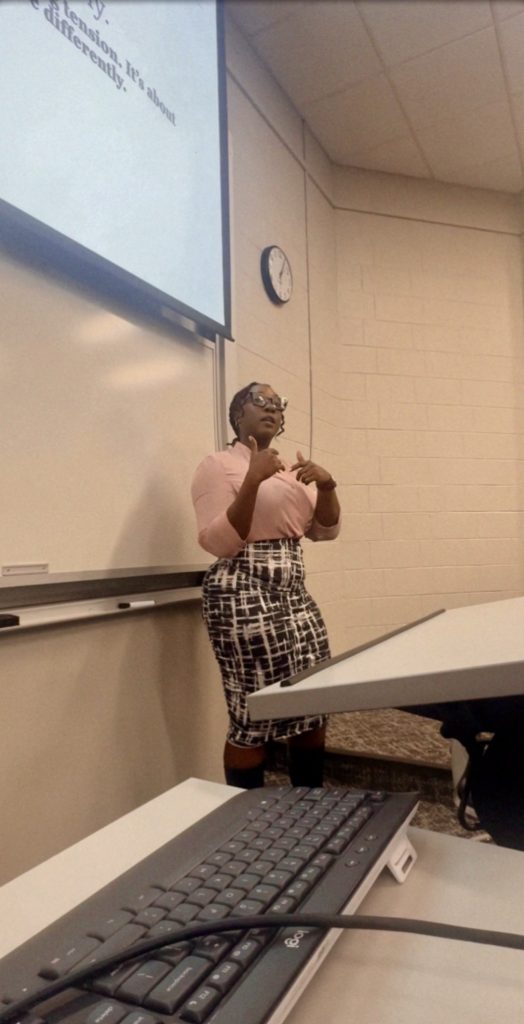
Yesterday evening, the Beta Alpha Psi Chapter at UNC Charlotte invited Dr. Brittani “Dr. Brit” Washington to speak, students expected a conversation about ethics. What they didn’t expect was a 17‑minute, story‑driven wake‑up call about the tiny, everyday decisions that quietly shape a career.
Her presentation, “The Smallest Decision That Will Shape Your Career,” reframed ethical decision‑making not as a philosophical exercise but as a practical survival skill for emerging professionals navigating fast‑paced, high‑pressure environments.
A Cold Start That Hit Home
Dr. Brit opened with a striking, cinematic moment:
A person holding a phone, thumb hovering over SEND.
No introduction. No easing in. Just a familiar, uncomfortable pause.
That moment, she explained, is what real ethical dilemmas look like. Not dramatic. Not obvious. Not labeled as “ethical.” Instead, they show up disguised as urgency, authority, or the desire to belong.
Her message landed quickly: Most ethical missteps come from good people trying to be fast, agreeable, or helpful, not from bad intentions.
Ethics as Performance, Not Philosophy
Throughout the session, Dr. Brit challenged a common assumption: that people will naturally rise to their values when pressure hits.
Her counterpoint was blunt and memorable: “People don’t rise to their values under pressure; they fall to their habits.
To help students build those habits, she introduced a simple, actionable 90‑second decision filter which operates as a mental checkpoint designed for those quiet, high‑stakes micro‑moments:
- Facts — What do I actually know
- Impact — Who could this affect
- Identity — Who am I becoming if I choose this
- Voice — What would I say if this decision were public
The framework wasn’t presented as a moral compass, but as a practical tool students could use before replying to an email, approving a shortcut, or agreeing to something that doesn’t feel quite right.
How to Pause Risk Without Creating Conflict
Understanding that young professionals often fear sounding confrontational, Dr. Brit also shared three short, non‑dramatic phrases that help slow down risky situations. These phrases give students a way to protect their credibility and alignment without escalating tension, which is a skill many wish they had learned sooner.
A Room Full of Realizations
As the presentation neared its close, Dr. Brit led the audience through a reflective hand‑raise sequence. The questions were simple, but the impact was powerful. Hands rose slowly at first, then almost unanimously.
The room discovered a shared truth: Most students had already faced ethical pressure. They just didn’t recognize it as training.
What many interpreted as personal uncertainty was actually early professional development.
The Message Students Took With Them
Dr. Brit ended with a message that resonated deeply:
Trust is the currency of a career.
Talent may open doors, but trust keeps them open.
Her presentation reminded students that ethical decision‑making isn’t a personality trait reserved for a select few. It’s a professional skill that must be practiced long before the high‑stakes moments arrive.
Students walked away with more than inspiration. They left with a framework, a set of habits, and a clearer understanding of how the smallest choices shape who they become in the workplace.
And that, Dr. Brit emphasized, is the real power of ethics:
– Not to make decisions heavier, but to make them clearer.
– Not to make them philosophical, but to make them usable.
– Not to make them distant, but to make them part of everyday life.